ロード中...
Petro-aggression : when oil causes war /
"Oil is the world's single most important commodity and its political effects are pervasive. Jeff Colgan extends the idea of the resource curse into the realm of international relations, exploring how countries form their foreign policy preferences and intentions. Why are some but not all...
| 第一著者: | |
|---|---|
| フォーマット: | Printed Book |
| 言語: | English |
| 出版事項: |
Cambridge :
Cambridge University Press,
2013.
|
| 主題: | |
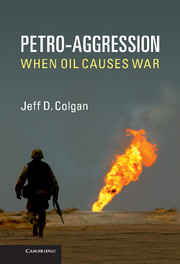
| オンライン・アクセス: | Cover image |
| LEADER | 02922cam a2200397 i 4500 | ||
|---|---|---|---|
| 001 | 17455684 | ||
| 003 | OSt | ||
| 005 | 20200307175920.0 | ||
| 008 | 120907s2013 enka b 001 0 eng | ||
| 999 | |c 277838 |d 277838 | ||
| 010 | |a 2012035321 | ||
| 020 | |a 9781107029675 (hardback) | ||
| 020 | |a 9781107654976 (paperback) | ||
| 040 | |a DLC |b eng |c DLC |e rda | ||
| 042 | |a pcc | ||
| 050 | 0 | 0 | |a HD9560.5 |b .C576 2013 |
| 082 | 0 | 0 | |a 355.02 COL.P |2 23 |
| 084 | |a POL011000 |2 bisacsh | ||
| 100 | 1 | |a Colgan, Jeff, |d 1975- |e author. | |
| 245 | 1 | 0 | |a Petro-aggression : |b when oil causes war / |c Jeff D. Colgan. |
| 264 | 1 | |a Cambridge : |b Cambridge University Press, |c 2013. | |
| 300 | |a xiv, 312 pages : |b illustrations ; |c 23 cm | ||
| 336 | |a text |2 rdacontent | ||
| 337 | |a unmediated |2 rdamedia | ||
| 338 | |a volume |2 rdacarrier | ||
| 504 | |a Includes bibliographical references (pages 272-291) and index. | ||
| 505 | 8 | |a Machine generated contents note: 1. Introduction; 2. A theory of oil, revolution, and conflict; 3. Evidence and research design; 4. Quantitative impact of oil and revolution on conflict; 5. Iraq; 6. Libya and the Arab Jamahiriyya; 7. Iran; 8. Venezuela and the Bolivarian revolution; 9. Saudi Arabia; 10. Does oil cause revolution?; 11. Conclusion and policy implications. | |
| 520 | |a "Oil is the world's single most important commodity and its political effects are pervasive. Jeff Colgan extends the idea of the resource curse into the realm of international relations, exploring how countries form their foreign policy preferences and intentions. Why are some but not all oil-exporting 'petrostates' aggressive? To answer this question, a theory of aggressive foreign policy preferences is developed and then tested, using both quantitative and qualitative methods. Petro-Aggression shows that oil creates incentives that increase a petrostate's aggression, but also incentives for the opposite. The net effect depends critically on its domestic politics, especially the preferences of its leader. Revolutionary leaders are especially significant. Using case studies including Iraq, Iran, Libya, Saudi Arabia and Venezuela, this book offers new insight into why oil politics has a central role in global peace and conflict"-- |c Provided by publisher. | ||
| 650 | 0 | |a Petroleum industry and trade. | |
| 650 | 0 | |a War |x Economic aspects. | |
| 650 | 7 | |a POLITICAL SCIENCE / International Relations / General. |2 bisacsh. | |
| 856 | 4 | 2 | |3 Cover image |u http://assets.cambridge.org/97811070/29675/cover/9781107029675.jpg |
| 906 | |a 7 |b cbc |c orignew |d 1 |e ecip |f 20 |g y-gencatlg | ||
| 942 | |2 ddc |c BK | ||
| 955 | |b xj12 2012-09-07 |c xj12 2012-09-07 ONIX |a rd01 2012-09-11 RDA review |a xj 2012-09-11 to GPSE |a xn09 2013-04-19 1 copy rec'd., to CIP ver. |a xj15 2013-05-08 (rda rev.) | ||
| 952 | |0 0 |1 0 |2 ddc |4 0 |6 355_020000000000000_COL_P |7 0 |8 NFIC |9 296134 |a POL |b POL |c REF |d 2020-03-07 |l 0 |o 355.02 COL.P |p POL20054 |r 2020-03-07 |w 2020-03-07 |y BK | ||