Cargando...
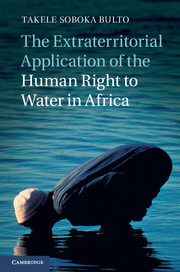
The extraterritorial application of the human right to water in Africa /
"International human rights law has only recently concerned itself with water. Instead, international water law has regulated the use of shared rivers, and only states qua states could claim rights and bear duties towards each other. International human rights law has focused on its principal m...
| Autor principal: | |
|---|---|
| Lenguaje: | English |
| Materias: | |
| Acceso en línea: | http://assets.cambridge.org/97811070/31081/cover/9781107031081.jpg |
| LEADER | 03074cam a22002418i 4500 | ||
|---|---|---|---|
| 005 | 20200730163934.0 | ||
| 008 | 131114s2013 enk b 001 0 eng | ||
| 020 | |a 9781107031081 (hardback) | ||
| 041 | |a eng | ||
| 082 | 0 | 0 | |a 341.231.14:32 |b BUL |
| 100 | 1 | |a Bulto, Takele Soboka, |9 1063 | |
| 245 | 1 | 4 | |a The extraterritorial application of the human right to water in Africa / |c Takele Soboka Bulto. |
| 300 | |a pages cm | ||
| 500 | |a Based on author's dissertation (doctoral) -- Melbourne Law School, University of Melbourne, 2011, issued under title: Rights, wrongs and the river between : extraterritorial application of the human right to water in Africa. | ||
| 505 | 8 | |a Machine generated contents note: 1. Introduction; 2. The human right to water at the global level; 3. The human right to water in the African human rights system; 4. The human right to water and states' domestic obligations; 5. The human right to water and states' extraterritorial obligations; 6. Extraterritoriality of the human right to water in international water law; 7. The human right to water and extraterritorial remedies; 8: Conclusion. | |
| 520 | |a "International human rights law has only recently concerned itself with water. Instead, international water law has regulated the use of shared rivers, and only states qua states could claim rights and bear duties towards each other. International human rights law has focused on its principal mission of taming the powers of a state acting territorially. Takele Soboka Bulto challenges the established analytic boundaries of international water law and international human rights law. By demonstrating the potential complementarity between the two legal regimes and the ensuing utility of regime coordination for the establishment of the human right to water and its extraterritorial application, he also shows that human rights law and the international law of watercourses can apply in tandem with the purpose of protecting non-national non-residents in Africa and beyond"-- | ||
| 520 | |a "This book joins the debate (albeit mainly from the perspective of the African human rights system) but, more importantly, goes ahead of the current controversy and analyses the immediate implementation problems triggered by declaration of the right given the shared nature of scarce water resources in regions such as Africa. Unlike or beyond the necessities of implementing other socio-economic rights, the human right to water often depends primarily on a uniquely international resource for its realisation. Of the 54 African states, 51 states are dependent for drinking and sanitation water on international rivers that are shared between/among 2-10 co- riparian states"-- | ||
| 650 | 0 | |a Right to water |9 1064 | |
| 650 | 7 | |a POLITICAL SCIENCE / Political Freedom & Security / Human Rights. |9 1065 | |
| 856 | 4 | 2 | |u http://assets.cambridge.org/97811070/31081/cover/9781107031081.jpg |
| 942 | |c BK |6 _ | ||
| 999 | |c 207297 |d 207297 | ||
| 952 | |0 0 |1 0 |4 0 |6 3412311432_BUL |7 0 |9 263767 |a SLS |b SLS |c CHR |d 2015-08-19 |o 341.231.14:32 BUL |p SLS029287 |r 2015-08-19 |w 2015-08-19 |y CHR | ||