South Asia
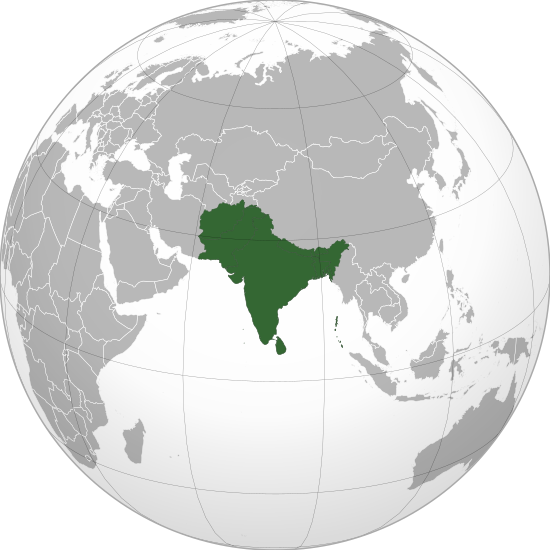 South Asia is the southern subregion of Asia that is defined in both geographical and ethnic-cultural terms. South Asia, with a population of 2.04 billion, contains a quarter (25%) of the world's population. As commonly conceptualised, the modern states of South Asia include Bangladesh, Bhutan, India, the Maldives, Nepal, Pakistan, and Sri Lanka, with Afghanistan also often included, which may otherwise be classified as part of Central Asia. South Asia borders East Asia to the northeast, Central Asia to the northwest, West Asia to the west and Southeast Asia to the east. Southeast Asia and Maritime South Asia are the only subregions of Asia that lie partly within the Southern Hemisphere. The British Indian Ocean Territory and two out of 26 atolls of the Maldives in South Asia lie entirely within the Southern Hemisphere. Topographically, it is dominated by the Indian subcontinent and is bounded by the Indian Ocean in the south, and the Himalayas, Karakoram, and Pamir Mountains in the north.
Settled life emerged on the Indian subcontinent in the western margins of the Indus River Basin 9,000 years ago, evolving gradually into the Indus Valley Civilisation of the third millennium BCE. By , an archaic form of Sanskrit, an Indo-European language, had diffused into India from the northwest, with the Dravidian languages being supplanted in the northern and western regions. By , stratification and exclusion by caste had emerged within Hinduism, and Buddhism and Jainism had arisen, proclaiming social orders unlinked to heredity.
In the early medieval era, Christianity, Islam, Judaism, and Zoroastrianism became established on South Asia's southern and western coasts. Muslim armies from Central Asia intermittently overran the plains of northern India, eventually founding the Delhi Sultanate in the 13th century, and drawing the region into the cosmopolitan networks of medieval Islam. The Islamic Mughal Empire, in 1526, ushered in two centuries of relative peace, leaving a legacy of luminous architecture. Gradually expanding rule of the British East India Company followed, turning most of South Asia into a colonial economy, but also consolidating its sovereignty. British Crown rule began in 1858. The rights promised to Indians were granted slowly, but technological changes were introduced, and modern ideas of education and the public life took root. In 1947, the British Indian Empire was partitioned into two independent dominions, a Hindu-majority Dominion of India and a Muslim-majority Dominion of Pakistan, amid large-scale loss of life and an unprecedented migration. The 1971 Bangladesh Liberation War, a Cold War episode resulting in East Pakistan's secession, was the most recent instance of a new nation being formed in the region.
South Asia has a total area of 5.2 million km2 (2 million sq.mi), which is 10% of the Asian continent. The population of South Asia is estimated to be 2.04 billion or about one-fourth of the world's population, making it both the most populous and the most densely populated geographical region in the world.
In 2022, South Asia had the world's largest populations of Hindus, Muslims, Sikhs, Jains, and Zoroastrians. South Asia alone accounts for 90.47% of Hindus, 95.5% of Sikhs, and 31% of Muslims worldwide, as well as 35 million Christians and 25 million Buddhists.
The South Asian Association for Regional Cooperation (SAARC) is an economic cooperation organisation in the region which was established in 1985 and includes all of the South Asian nations. Provided by Wikipedia
-
1
-
2
-
3
-
4
-
5
-
6
-
7
-
8Published 1993“...South Asia Seminar...”
Printed Book -
9Published 1986“...Joint Committee on South Asia...”
Printed Book -
10Published 1980“...Joint Committee on South Asia...”
Printed Book -
11Published 2000“...Association of Management Development in South Asia...”
Printed Book -
12Published 2011“...International Relations Theory and South Asia (Project)...”
Get full text
Get full text
Get full text
Printed Book -
13Published 2008“...South Asia Human Rights Documentation Centre...”
Printed Book -
14Published 2006“...South Asia Human Rights Documentation Centre...”
-
15“...Conference on 'Poverty in South Asia' Oxford, England...”
Printed Book -
16by Noorani, A. G.“...South Asia Human Rights Documentation Centre...”
Published 2012
Contributor biographical information
Publisher description
Table of contents only
Printed Book -
17Published 2000“...South Asia Human Rights Documentation Centre...”
-
18Published 2001“...South Asia Human Rights Documentation Center...”
-
19Published 1991“...University of California, Berkeley. Center for South Asia Studies...”
Printed Book -
20Published 2004“...Conference "Representing the Body in Colonial and Post-Colonial South Asia"...”
Table of contents
Contributor biographical information
Publisher description
Printed Book